

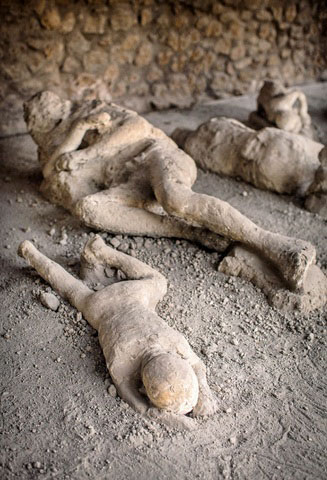
Archaeology is entering a new era—one where artificial intelligence is not just analyzing the past, but visually reconstructing it. In a striking development reported from Pompeii, archaeologists have used AI for the first time to generate a realistic image of a victim of the catastrophic eruption of Mount Vesuvius in AD 79.
The result is more than a scientific illustration. It is a deeply human portrait of a man frozen in his final moments nearly 2,000 years ago.
Reconstructing a Lost Moment in Time
The AI-generated image was produced by the Pompeii Archaeological Park in collaboration with researchers from the University of Padua. It depicts a man fleeing through volcanic debris, shielding his head with a large terracotta vessel as ash and rocks rain down from an erupting Vesuvius in the background.
This visualization is based on the discovery of human remains found near one of Pompeii’s southern gates. Archaeologists believe the man was attempting to escape the city when he was struck and killed during the eruption’s early phases.
Alongside his remains, researchers found everyday objects—an oil lamp, a small iron ring, and ten bronze coins—offering a rare snapshot of personal life abruptly interrupted by disaster.
AI as a New Archaeological Tool
What makes this development especially significant is not just the image itself, but the method behind it. Researchers combined excavation data, skeletal analysis, and digital reconstruction techniques with AI modeling to infer facial structure and environmental context.
Pompeii’s archaeological leadership has described AI as a powerful new tool for both research and public engagement. According to director Gabriel Zuchtriegel, artificial intelligence could help manage the vast volume of archaeological data emerging from sites like Pompeii while also making ancient history more accessible and emotionally resonant.
Rather than replacing traditional archaeology, the technology is being framed as an extension of it—one that bridges scientific evidence with visualization.
Why This Matters Beyond PompeiiPompeii has always occupied a unique place in the public imagination. Preserved under volcanic ash for nearly two millennia, it offers an unparalleled snapshot of Roman life at the moment of destruction. But until now, much of that record has been fragmented—bones, artifacts, and impressions of bodies left in ash.
AI changes that relationship. It allows researchers not only to analyze remains but to synthesize them into something closer to lived experience: faces, expressions, and context.
This shift has implications far beyond a single archaeological site. Similar techniques could eventually be applied to other ancient remains around the world, helping historians visualize individuals who would otherwise remain anonymous to history.
The Ethics of Reconstructing the Past
Of course, this technological leap also raises important questions. How accurate can AI-driven reconstructions truly be? Where is the line between scientific interpretation and speculative visualization?
Archaeologists emphasize that these images are not definitive portraits but informed reconstructions grounded in data. They are best understood as hypotheses—visual tools that communicate possibilities rather than certainties.
Still, even with those limitations, the emotional impact is undeniable. Seeing a reconstructed face attached to a set of remains transforms abstract history into something personal and immediate.
A New Way of Seeing Ancient Lives
The Pompeii AI project represents a broader shift in archaeology: from uncovering artifacts to reconstructing human experience. It is part science, part storytelling, and part technological experimentation.
As AI continues to evolve, it may increasingly serve as a bridge between the distant past and the present—helping us not only to study ancient civilizations, but to see them.
And in the case of Pompeii, it reminds us that history is not just about cities buried by volcanoes or dates carved into stone. It is about individuals—people who lived ordinary lives, and in an instant, became part of extraordinary history.